

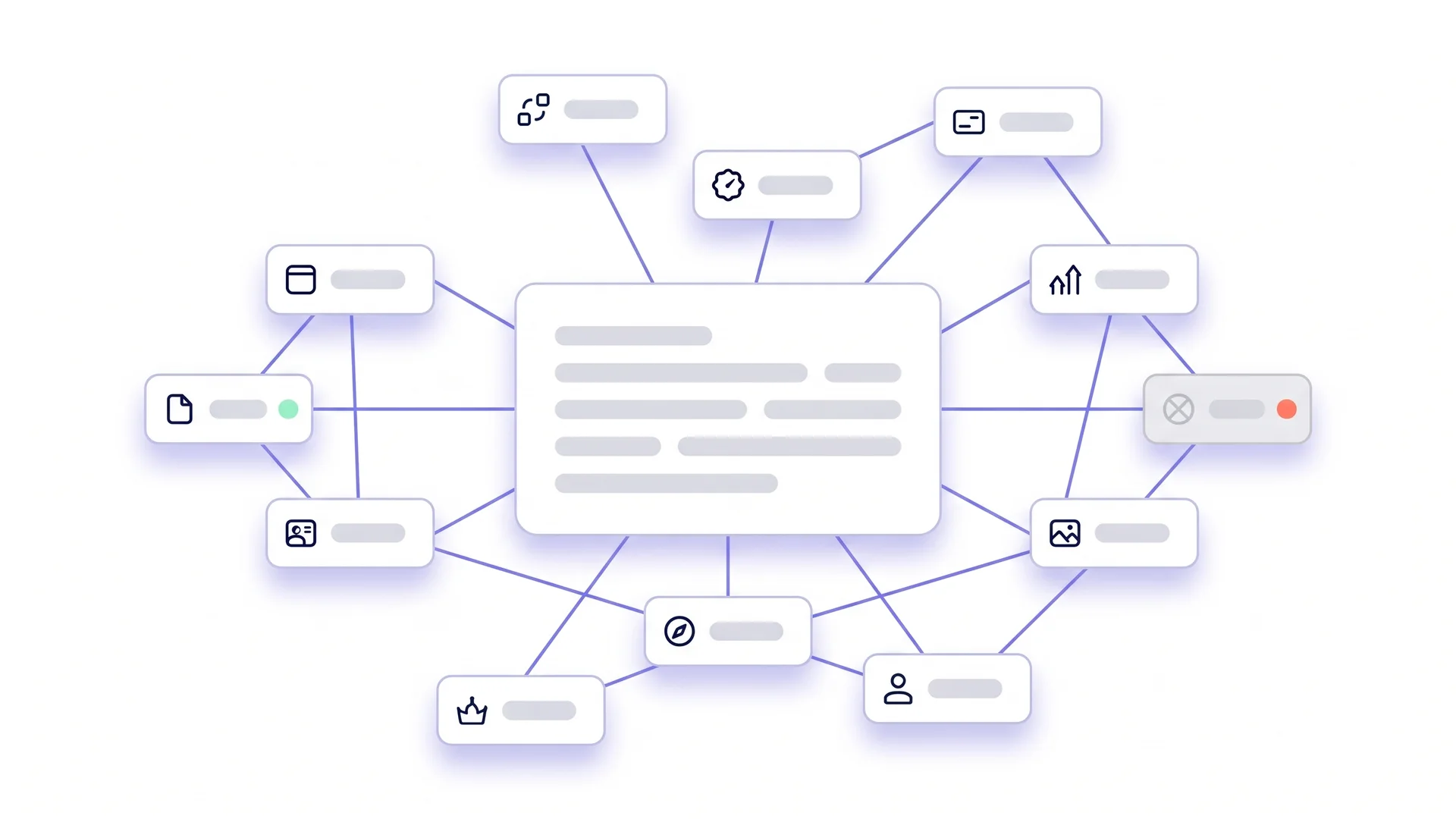
A site with 40 articles on one subject usually outranks a site with 400 articles on 40 subjects, on that one subject. Not because Google counts articles. Because depth produces exactly what Google does measure: pages that answer the whole question, sensible links between them, and a site whose purpose is obvious. That pattern has a name, topical authority, and a method, the cluster map.
 Key Takeaways
- Topical authority is coverage plus coherence: a site that answers a subject completely, with pages that link to each other in a structure a reader and a crawler can follow
- Google does not use the term, but its guidelines reward what it describes: a clear site focus, go-to sources for a topic, and comprehensive content
- A cluster map is the plan: one pillar page per topic, supporting pages for each sub-question, and deliberate links between them
- Authority decays with the facts in it. A cluster that was complete and current in 2024 is neither in 2026 without maintenance
What is topical authority?
Topical authority describes how far a site counts as a complete, reliable source for a subject. For search engines, for AI systems and for the people searching. It is earned three ways. Cover the subject thoroughly, keep the coverage accurate, and connect it so a reader can move from any question to the next.
The term is an industry one, not a Google one. Google does not publish a topical authority score. What it publishes is a set of criteria that describe the same outcome from different angles:
- Its Search Quality Rater Guidelines define Authoritativeness as being known as a go-to source for the topic.
- Its helpful-content guidance asks two things: does the site have a primary focus, and does the content describe the topic comprehensively?
- Its ranking systems documentation describes link analysis that works out what pages are about from how they link to each other.
Put those three together and you have topical authority, just without the label. A focused site, comprehensive coverage, and a link structure that says what the pages are about. We introduced Authoritativeness as one of the four E-E-A-T elements in E-E-A-T explained. This article is about building it deliberately for a subject.
Why does topical authority matter more than page count?
Because the signals that rank a page for a hard query are mostly site-level. A scattered site has too few of them for any single subject.
Consider two sites competing for “content audit template”. Site A has one article on it and 300 articles on unrelated marketing topics. Site B has that article plus fifteen others on content audits, content inventories, content decay, refresh strategy and update cadences, all linking to each other. For a rater, site B is the go-to source. For the link analysis systems, site B’s internal links say clearly what the audit article is about and how it relates to the rest. For a reader, site B answers the next question without leaving.
Three concrete effects:
- Internal links carry meaning. A link from a page about content inventories to one about content audits, with descriptive anchor text, tells Google exactly what the target is about. Google’s link best practices put anchor text at the centre of that. Scattered sites cannot build those links because the related pages do not exist.
- Coverage answers follow-up queries. Searchers rarely stop at one question. A site that has the follow-ups gets the second, third and fourth visit, and the engagement signals that come with them.
- Focus reads as expertise. Google’s helpful-content questions ask about a primary focus for a reason. A site that publishes deeply on one subject is more likely written by people who know it. That is Expertise and Authoritativeness at the site level.
Topical authority is subject-specific. A site can be the go-to source for content freshness and have no authority at all on email marketing, even with the same authors. Every new topic starts from zero and needs its own cluster.
How do you build a topical cluster map?
By turning a subject into a structured set of questions, assigning each question to a page, and connecting the pages deliberately. Five steps.
Step 1: Define the topic boundary
Write one sentence that says what the topic is and what it is not. “Content freshness: keeping published content accurate, current and citable over time. Not: content creation, keyword research, link building.” The boundary decides what belongs in the cluster and, more importantly, what does not. Without it, clusters sprawl into everything adjacent and lose the focus that makes them work.
Step 2: Collect every question the topic contains
From four sources. The queries you already rank for in Search Console. The related questions around your core terms. The questions customers actually ask. And your own sense of what someone needs to know. For a mid-sized topic this produces 30 to 80 questions. Group duplicates.
Step 3: Assign questions to pages
Not every question is a page. The rule: one page per distinct search intent. Questions that share an intent share a page; questions with different intents get their own. The result is a hierarchy:
- Pillar page: the broad guide to the whole topic. The page you would send to someone asking what X is and how to do it. Comprehensive, structured, linking out to everything below.
- Supporting pages: one per sub-question with its own intent. Deep on that question, linking back to the pillar and sideways to related supporting pages.
- Answered inside a page: questions too narrow for their own URL, handled as a section or FAQ entry on the relevant supporting page.
Our own content freshness cluster looks like this in practice. E-E-A-T explained and the content audit guide act as pillars. Around them sit supporting pages on update cadence, outdated statistics, content inventory, pruning and dates, each linking to the pillars and to its neighbours.
Step 4: Design the links before writing
For each page, list which pages it must link to and with what anchor text, before a word is written. The pillar links to every supporting page. Every supporting page links to the pillar and to at least two siblings where the relationship is real. Anchor text describes the target (“how often to update content”), not the action (“click here”). This is where topical authority becomes machine-readable: Google’s link systems read exactly these connections.
Step 5: Sequence the production
Pillar first, or the two or three supporting pages that answer the highest-volume questions first with the pillar immediately after. Then the rest in order of search demand and strategic value. Publishing on a schedule keeps the cluster growing visibly. We use one article every three days. That growth is itself a freshness signal for the whole section.

 Richard Roth Founder CiteRanger, SEO Strategist
The mistake I see most often is a cluster designed backwards: someone writes twenty articles and then draws a map around them. The map is supposed to come first, because it is the map that decides which articles are missing and which are redundant. When we planned this site’s cluster, the map produced eighteen articles. Six of the topics I would have guessed were not on it, and two I was sure about turned out to be sections of other pages.
How do you know the cluster is working?
By watching the signals that topical authority produces, at the cluster level rather than per page. Four measures, checked monthly:
| Signal | Where to see it | What to look for |
|---|---|---|
| Rankings for the topic’s queries | Search Console, filtered by the cluster’s pages | The share of the topic’s queries where any cluster page ranks in the top 20 rising over time |
| New queries appearing | Search Console, queries with impressions but no prior history | Long-tail questions you did not target starting to show, a sign the site is being treated as a source for the subject |
| Internal navigation | Analytics, pages per session for cluster entries | Readers moving between cluster pages instead of leaving |
| External citation | Backlink tool, AI answer checks | Other sites and AI answers referencing cluster pages as sources |
The second signal is the clearest. Watch for impressions on questions no page specifically targets. When those appear, the systems have started treating your site as a place to look for that subject. That is topical authority, observed.
Add a “cluster” column to your content inventory and group Search Console exports by it. Cluster-level trends are visible months before individual pages move, and they tell you whether to keep investing in the topic or whether the map needs more pages.
How does topical authority decay?
The same way everything on this site decays: through facts that expire and links that break. A cluster is a set of claims about a subject, and a subject moves. The tool a supporting page recommends is discontinued. The statistic the pillar leads with is superseded. The regulation a page explains is amended. Each expired fact is a trust leak, and trust is the element that Google’s raters weigh above all, as we showed in trustworthiness.
Authority decays faster than page count suggests because the expired facts sit in the pages that get the most traffic and the most citations. A pillar with a stale headline number does more damage than a supporting page with one, because it is the page other sites point to.
Maintenance for a cluster:
- Cadence per page type. Pillars quarterly, supporting pages by the update cadence for their content type.
- Link integrity. Once a month, check that every internal link in the cluster still resolves to the intended page. And that every external source still exists and still says the same thing.
- Coverage review. Twice a year, repeat step 2 of the map: new questions in Search Console, new “People also ask” entries, new customer questions. Add pages for genuinely new intents; extend existing pages for the rest.
- Monitoring on the pillars. The pages that define the cluster deserve continuous checks on their facts and sources, because they are the ones that decay in public. That is the part you can hand off. The fact check scans the cluster’s pages for outdated statements and dead sources, so the map stays as accurate as it was on day one.
How does topical authority work for AI search?
AI systems and Google’s AI features benefit from the same structure, for a reason that is obvious from their side. A system looking for a source prefers a site that covers the subject completely and with current facts. Such sources make its answer wrong less often.
Google’s documentation on AI features in Search says the same foundational practices apply as for Search overall. Comprehensive, connected, current coverage is exactly that foundation. How systems pick sources is covered in how AI search engines choose which sources to cite. A coherent cluster gives them a source that holds together across many questions, instead of a single page standing alone.
One practical consequence: consistency across the cluster matters more for AI systems than for human readers. If the pillar says quarterly and a supporting page says monthly, a human reconciles it; a system sees a source that contradicts itself. Cluster maintenance includes keeping the pages in agreement.
Conclusion
Topical authority is not a score and not a trick. It is what a site earns when three things come together. Complete coverage, a connection readers and systems can follow, and pages that stay accurate. Google does not use the term. Its guidelines describe the outcome from three directions though: a focused site, recognisable go-to sources, and links that explain what pages are about.
Draw the map before writing. One boundary, every question, one page per intent, links designed in advance, production in sequence. Then maintain it, because a cluster is only as authoritative as its oldest unchecked fact.
Two related questions come up whenever authority is discussed. First, what Domain Authority measures and why Google does not use it. Second, how to earn authority without buying links.